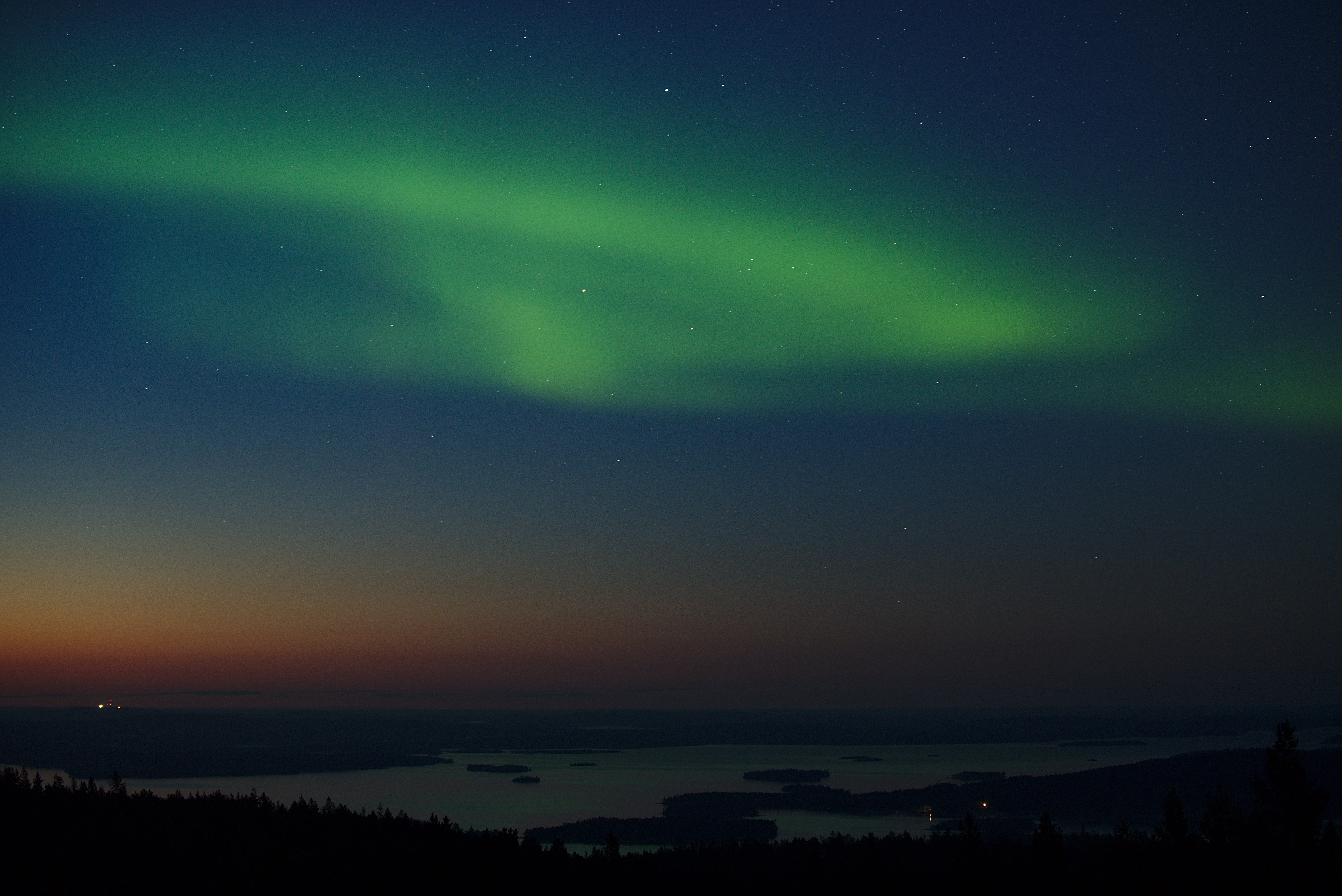

The first auroras of the new saeason have been dancing over Orava’s Nest in the night of August 28th to 29th, 2026.
That is, in fact, the question I am asked most often when someone enquires about the heavenly lights before making a booking. My standard answer is always: “At night.” While that may sound funny at first, it is not said without reason.
On one hand, a long-exposure photograph can brighten the landscape dramatically, and the moon can easily be mistaken for the sun.
Even if you are shaking your head right now: it happens more often than you might think.
On the other hand, we in Lapland enjoy the privilege of the midnight sun for two months. For roughly six weeks before and after that period, the twilight, or “night”, is still too bright to see any stars, let alone the northern lights.
The aurora season in Finnish Lapland: late August to mid April
As my standard answer sums it up, a dark sky is the fundamental requirement. The aurora season in Finnish Lapland runs roughly from the last days of August to around mid April.
The strength of the solar storm also determines the exact day on which we celebrate the return of the lights.
The earliest date in the last 10 years was 26 August 2023.
Why do I remember that so well, you ask?
Simple: I make it a habit to photograph the first northern lights of every season. A look through my extensive archive confirmed it. And while we are at it, 28 August holds the record, with three “first northern lights” since 2016.
It is quite possible that I missed one or two “first northern lights” along the way, because the one factor that limits everything, the weather, did not cooperate.
As darkness sets in a little earlier each day, the chances increase accordingly. It is fair to say that an aurora season in Ivalo runs from early September to the end of March. At any point within that window you have a realistic chance of seeing the northern lights, as long as the sky is clear and the sun is active enough.
As long as the lakes and rivers are not yet frozen, the dancing lights reflect on the water surface. That this adds yet another dimension to an already extraordinary natural phenomenon is something everyone can well imagine.
Depending on the year, snow arrives as early as October and stays until spring.
When only a few leaves remain in early October to tell stories of the colourful September, the dark season begins. Everything waits for the first snow, which will brighten the landscape and the nights in general. With each passing week the days grow shorter and the nights correspondingly longer, meaning more hours of darkness to search for the lights. When the sun sets for the last time this year in early December, the polar night begins, called “Kaamos” in Finnish. The few hours of twilight drape the white landscape in a wonderfully blue light. (“What is that?” “That is blue light.” “And what does it do?” “It shines blue.” Rambo III)
At the same time, you can sometimes watch the northern lights from 3 in the afternoon until 8 in the morning. Do not ask me how I know that…
Once the sun climbs back above the horizon around 10 January, the nights shorten again quickly. Within a week the days grow by roughly an hour and a half. Eventually they become long enough and the nights too bright, and we have to say goodbye to Lady Aurora.
Why Ivalo and Orava’s Nest give you such good odds
Our Orava’s Nest sits far enough north that around 80% of solar storms strong enough to produce auroras reach Ivalo. Even relatively low solar activity can produce green bands in the sky here, provided the weather cooperates.
Orava’s Nest is also far enough from man-made light pollution. The sky here is naturally dark, so on moonless nights you can see the proverbial millions of stars and the Milky Way with the naked eye. Our 40,000-square-metre private property is surrounded by forest, with open views of the sky: from the terrace, from the clearings behind the house, or simply from the comfort of your bed. You will love the northern lights just as much as my wife and I do. Every aurora photo you see on our website was taken right here on the property.
Another big advantage is flexibility. Since you are staying in a private holiday home, you can step outside the moment you see the first signs of an aurora starting. No waiting for a bus, no schedule to follow, no sharing the view with large crowds. When conditions look especially promising, we also offer aurora tours that venture even deeper into the wilderness.
Solar activity and the KP index, explained simply
Auroras start on the sun, not in Lapland. When the sun sends out streams of charged particles, they interact with Earth’s magnetic field and atmosphere, creating light in the polar regions. One of the easiest tools you will see in apps is the KP index.
The KP index is a scale from 0 to 9 that describes how disturbed Earth’s magnetic field is. In simple terms: the higher the KP number, the further south the auroral oval expands. Here in Ivalo, which sits well inside the usual auroral zone, we do not need extreme KP levels to see the lights. On many nights a modest KP 2 or 3 can bring beautiful displays right above Orava’s Nest.
When you are planning your trip, you cannot know the KP index months in advance. Forecasts only become useful a few days, and sometimes only a few hours, before the activity reaches Earth. This is why we always say that choosing a good time within the broader season and staying for several nights matters far more than chasing a specific KP value.
Weather, clouds and why a rental car helps
The biggest variable on any given night is not solar activity, it is weather. Clear or partly clear skies matter more than temperature. We have seen beautiful auroras at minus 30 degrees and just below freezing, but only when the clouds stayed away. High, thin clouds can sometimes be tolerated, but thick, low clouds will block most of the light.
In Ivalo, weather can change quickly. A cloudy evening can open up after midnight, or a clear spell can drift in from the north for just an hour. This is where having a rental car becomes essential if you are serious about seeing the northern lights. With a car you can use local cloud maps to drive 20 to 60 minutes in the direction of clearer skies, escape a stubborn cloud layer, and suddenly find yourself under an open window of stars and aurora. Anyone who does not see them during the aurora season here has simply not tried hard enough to find an open patch of sky.
Wind can help too, because it moves cloud layers and can create gaps. The cold, dry air of mid winter often brings sharper stars and more contrast, while autumn and spring can offer softer, milder nights that are easier on your fingers and toes.
Setting expectations and planning your own aurora story
No matter when you visit, it is important to remember that the aurora is a natural phenomenon. Nobody can guarantee a display on a specific night, even in the best locations. There will always be some guests who do not see the lights, and others who experience them several nights in a row.
What you can do is tilt the odds in your favour. Choose a time within the main aurora season from late August to mid April. Stay for at least three or four nights so you can wait out a cloudy evening or two. Pick a location like Ivalo with dark skies and a position under the auroral oval. Then be ready to step outside when the forecasts point to activity. If you are specifically wondering when the best time to see the northern lights in Finland is, think less about one perfect date and more about giving yourself several nights within this window.
Here at Orava’s Nest we keep an eye on both the weather and the aurora data and are always happy to share real-time advice. For guests who want expert guidance, we offer small group aurora tours for 180 euros per person and dedicated aurora photography workshops for 250 euros per person. So far our guided aurora tours have a 100% success rate, because we are ready to drive, wait, and watch the sky together with you.
If you would like to add guided experiences to your stay and give yourself the very best chance of seeing the aurora, you can request our aurora tours directly on our aurora tours booking page. We would love to welcome you to Ivalo and help you write your own northern lights story here in Finnish Lapland.
Would you like to experience the northern lights yourself? Write to me and we will plan your adventure together.
If you enjoyed this post, feel free to share it with someone who might enjoy it too. Stay curious, listen for the squirrel whispers, and see you in the next post.
Leave a Reply